Anali Taherian
Storyless
September 5 -19, 2026
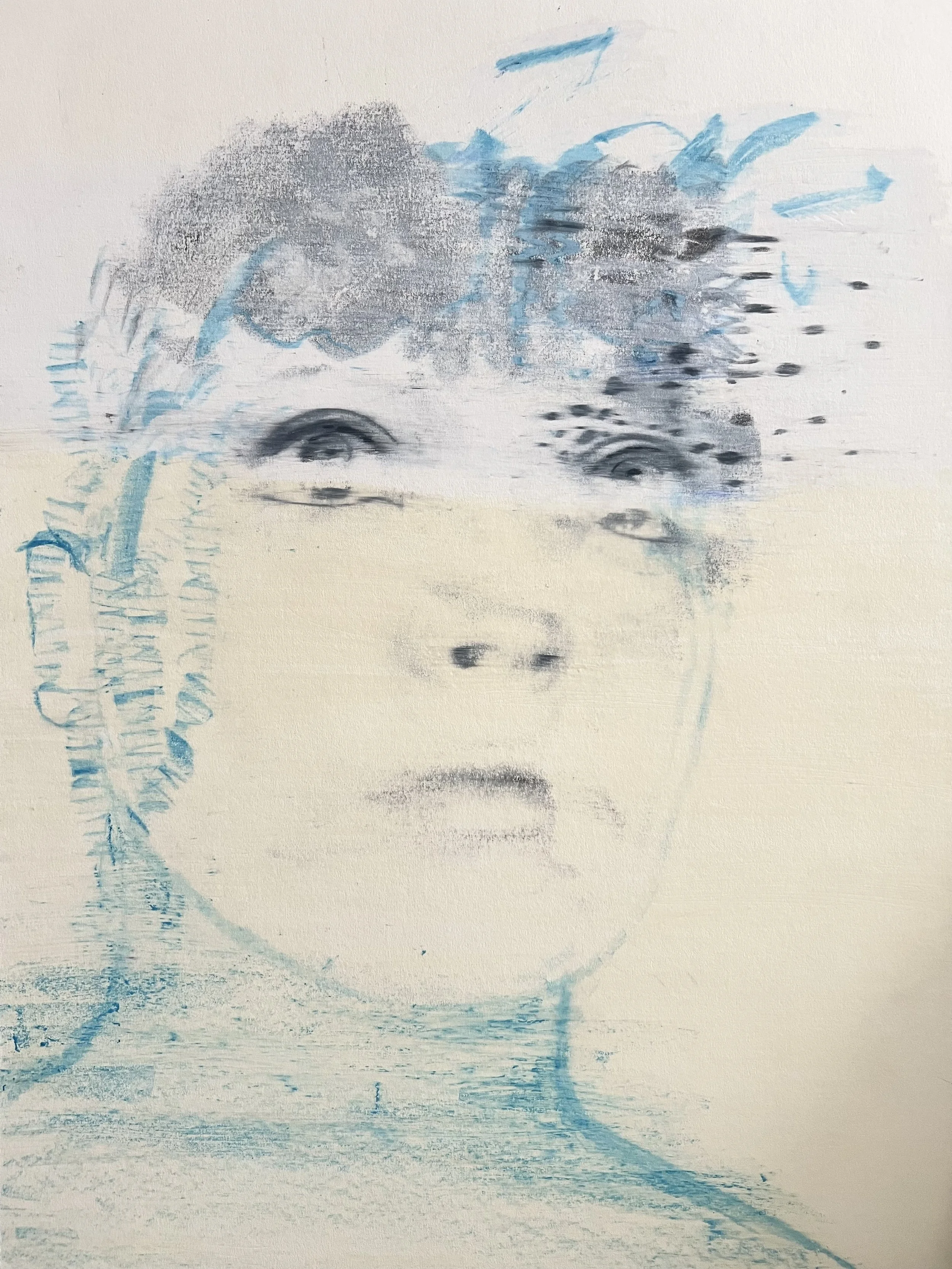
To understand what Anali Taherian’s portraits signify, one must first articulate what they refuse to signify - and more importantly, question the very notion of signification itself. It is as if she never intended for her portraits to point toward a specific concept, nor to unfold a narrative through a set of visual signifiers. By resisting conventional semiotic signs, these works dissolve any ease of identification, preventing us from projecting our own stories onto the portraits. Here, there is no narrative to speak of; what remains is an immediate, unmediated encounter that resonates deeply within the viewer’s very flesh and soul. Within this realm, only bodies perceive, communicating through a chain of affects - a unique mode of connection that operates independently of thought or consciousness. In her portraits, Anali Taherian facilitates this direct encounter through free association: a black eye shifts into a hollow, and from the depths of its darkness, opens a passage that grants viewers access to their own latent, submerged layers. A mouth turns into a fissure through which the portrait transcends its own boundaries, acting as a threshold into the space outside the frame. Within this shared convergence, we stand, embodying and absorbing every emotion flowing through the artwork. Consequently, the painter's true calling is the liberation of these sensations, pulling them out from beneath the facade of patterns and motifs: Faces dissolve, lines collapse and ignite, clearing the path for the raw facticity of human existence - liberated from name, occupation, class, or race, leaving only humanity in its primal essence. We are now confronted with the human archetype: an entity of flesh, veins, and roots. This is a human who feels and is now destined to share these sensations with other bodies, other flesh, other veins, and other roots. Anali Taherian’s Paintings stand as an active attempt to manifest this shared experience, forging entirely new collective bonds. If the nineteenth-century canvases of Édouard Manet confronted us with portraits trapped within the picture plane - holding the viewer captive with a static gaze - Taherian’s portraits refuse this enforced isolation. Instead, they break free from their own boundaries and the enclosure of the canvas, seamlessly intertwining with other bodies.